Saturday, October 16, 2010

Eggplant Parmesan

We have a glut of eggplant, so I fry them up and freeze them.  This year I also made a lot of sauce and froze that too, rather than canning just tomatoes (we have plenty left from last year).

Just washed fresh eggplant from our garden.  I've found the medium-sized ones work best.  Too small and they may have a bitter taste, too big and the seeds will be too developed.


I peel and slice them, then dredge in flour, beaten egg & water, and then breadcrumbs mixed with salt, pepper, fresh parsley and parmesan cheese.  You could also salt the eggplant slices first to draw out water.  I get about four ready to go, so I don't have to stop and slice more while the oil is hot.
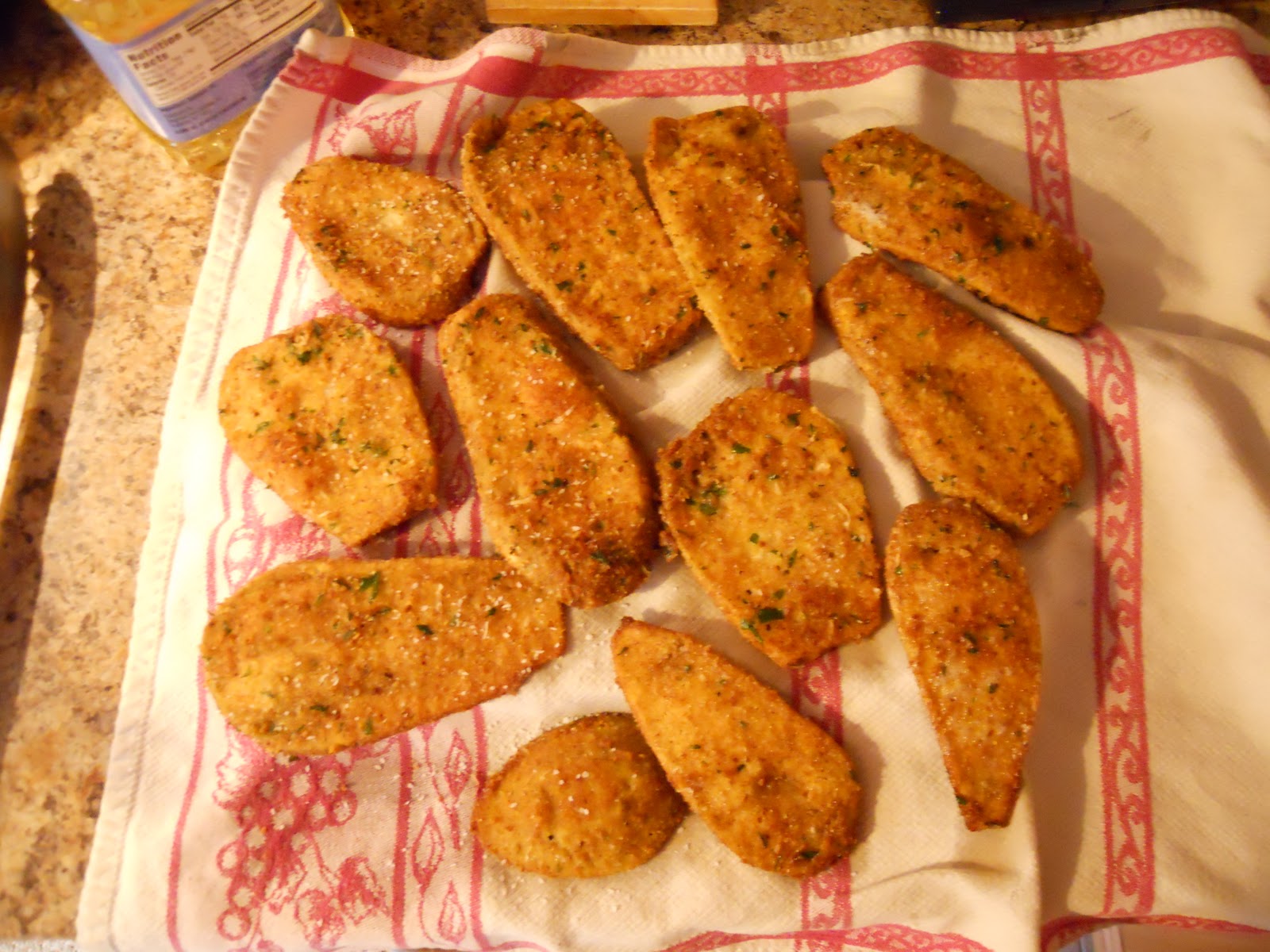
Then I fry up the eggplant in hot oil till it is golden brown on both sides.  Drain on a papertowel or tea towel.  Lay eggplant in the pan, overlapping slightly.  Layer parm & mozzerella cheese, tomato sauce, ending with mozzerella on top.


Homemade tomato sauce is best.  This is Fresh Tomato Puree from Julia Child's cookbook.  Basically it is tomatos that have been put through a foodmill, onions, herbs salt and pepper.  Super simple and delicious. 


The finished product:  it went so fast I didn't get to take a picture while it was whole!


Monday, October 4, 2010

Fall!

Oooh, I'm embarrased that I haven't written anything since August!  Yikes!  We have been in a holding pattern of weeding and harvesting tomatoes, eggplants, peppers and squash.  I fry up the eggplants (most of them) and freeze them for eggplant parm during the winter, and I make sauce out of the tomatoes.  So that has been taking most of my time.  I halve the peppers and freeze them too.  The squash should keep as-is throughout the winter.

Some things we can say from this year:  the red plastic mulch seemed to work for the tomatoes, we had a good crop of them this year and they ripened in staggers.  The silver plastic mulch worked for the eggplants and peppers.  We had less of a problem with flea beetles this year.  We didn't care much for the black paper biodegradable mulch.  It breaks down too quickly, and dogs running through it pretty much destroy it!  We will probably go back to using hay to mulch around the plants next year.  It just seems to keep the weeds in check better than we can.  The best tomato sauce recipe we've found is Julia Child's fresh tomato puree recipe.  It is easy and tastes great.  We also found out that if the basil plants get too big and out of control, just hack them back to the 2nd or 3rd bud and they'll come back nicely. 

Last weekend we pulled out the fence and mowed down the back half of the garden.  We put down tarps to use the stale seed bed method to kill weeds.  Then in a couple of weeks, Pat will plow and/or disc the ground and plant some winter ground cover.  Next year we plan on orienting the garden differently. 

Thursday, August 12, 2010

Peas!


Peas in the sink, on the counter and on the stove.
Snow peas in the sink
Ok, so this is a bit out of date, but I couldn't resist posting the pictures anyway--I love the colors!  We got a bumper crop of peas this year.  Snow peas and regular shell peas.  We got the kind that you can eat the pods too.  Since peas come on and go out so quickly, we only had about two weekends where we picked peas, but boy did it add up!  We picked, blanched, flash-froze, packaged and put in the freezer more than a 5-gallon bucketful.  After we freeze them individually we package them in vacuum-seal bags in portions enough for a meal.

After I blanch the peas, I lay them out on cookie sheets and freeze them overnight.

Friday, July 16, 2010

Pat's bees

Pat opened the bee boxes as he usually does during the weekends.  We have two hives--an old one and a new one.  The old one was started last year, and the bees are docile and friendly.  We almost never get stung by the old bees.  They have a hive body (two big boxes for their brood, honey and pollen to keep the hive going) and two supers (smaller boxes of of honey which can be harvested).  The new bees were started from a package this year, and have only a hive body and one super.  These bees are not docile and friendly though--they are aggressive and will sting with little provocation.  Pat can get away without wearing the bee suit for the old hive, but not the new one.  The do not like to have their hive opened!  Pat thinks that the difference is genetics.  The old hive's queen was bred to be docile, and the new hive's may not have been.  He thinks he may re-queen the hive with one from the old hive, if we can find a queen cell. 
Pat examines a frame from a super of the old hive.  Notice he doesn't have the gloves on.


He pulls out the frame to see how much honey the bees have stored.  These top boxes (the supers) are for honey storage that is extra.  We can take these and not hurt the colony during the winter. 


Pat smokes the bees in the old colony.  The smoke makes the bees calm down.  It makes them think there is a forest fire, and in a fire bees gorge themselves on honey.  So when you puff smoke in the hive, they disappear into the hive and stick their heads into the comb.  Just a little smoke keeps the old hive in check.


The photo is kind of blurry, but what it shows here is capped honey.  This is what we want!  The cells that look like they are glistening are uncapped honey.  The bees bring back nectar and store it in the comb cells one dropful at a time until the cell is full.  Then the worker bees fan their wings to create air circulation.  They do this until they drive off most of the water in the nectar.  When they have it right, they cap it for storage.  

Pat estimates that we will get about 60 lbs of honey this year!  This is only our 2nd year for bees.  The triangular panel to the right in the picture is a bee escape.  It is to allow the bees to get out from the super so that next weekend we can harvest.

Saturday, June 26, 2010

D-Day for Chickens

Well, we knew it was coming.  The old chickens had lived out their useful life.  I know, I know...as a vegetarian I should be opposed to any animal deaths.  And I am opposed to animal cruelty and useless suffering.  But I am also a realist and I understand that these are not wild animals that have been penned up cruelly, but are animals bred to provide eggs and meat.  They wouldn't exist without human intervention.  So when they started loosing feathers and their keels started showing out of their breasts, we knew it was time.

Mom, Dad, Pat and I all helped.  It was a group effort.  It was very humane.  Mom even prayed before we began to thank the chickens for all the eggs they provided our family and for the yummy chicken soup that would be to come.  With that, we began.

We set up on the driveway and in the garage.  Pat had built a killing cone.  Dad put the chicken head down inside the cone, pull its neck straight and slit its throat.  It bled out into a trashcan filled with sawdust. 


Then Dad dunked the chicken in 150 degree water, in a big pot on the camp stove in the garage.  Once the feathers pulled off easily, he gave it to Mom and me and we plucked it.


Mom and I plucking chickens.


Then Pat gutted them, I helped too. 


Dad, showing off one of the finished birds.


Final step, hose everything off and then spray with bleach-water.  And pack the chickens in vacuum-sealed freezer bags.
  They're not "oven-stuffers" but they will be good to use for stock or to pick off of the bone for soup.

Shingles!

We've got the shingles, finally, for the cabin.  After much ado, and missed delivery dates, we drove to York and picked them up ourselves--all 1600 lbs of them!  We got cedar shingles from Canada and they were supposed to be delivered to our farm, but things got mixed up and they kept being delayed.  But here they are, safe and sound on our porch:

There was a little bit of learning curve, for me, to hang them.  But once we got a system going it went pretty quick.  They have a 5" overhang, and we snap a chalk line to line the bottom up against so they are nice and straight.  

We started on the side.  This is what we got done after one full day.  Not bad!

The tricky part is around the gables under the roof.  Lots of angles and takes some time.

Most of the first side is done.  We'll use some kind of stain to finish it once they are all up.  I haven't decided yet if I want a colored stain to keep it the cedar color, or if we should just keep it clear and let it age naturally to a gray color. 


Flycatcher family

We had a family of flycatchers raised on our porch!  They watched us when we were sitting on the porch or having breakfast.  Frank and Fiona Flycatcher would hang out on branches and chirp at us.  They built their nest out of lichens and mosses up on the top beam of the porch roof.  They finally fledged last weekend.  here are some pics of their family
Here's their nest the first time we noticed it.  There may have been eggs inside, but I didn't want to disturb them to find out.

Mother or father  
Mother and father!


Kind of blurry, but this is the mother flying away after feeding the babies.


Believe it or not, there are five little birds up here.  They are just about to fledge and they've been trying out their wings...to the detriment of their nest.  Some of it is falling apart now.


Below is the mother feeding the babies, one has its mouth open.  They were gone the next weekend.